Portal
Portal is a good workout game when you want your brain busy and your legs moving at a steady pace, since each test chamber gives you a clear puzzle to solve. It is less suited to a hard run: aiming portals and judging where you will land both take enough attention that you may want to keep the treadmill speed sensible.
Gameplay
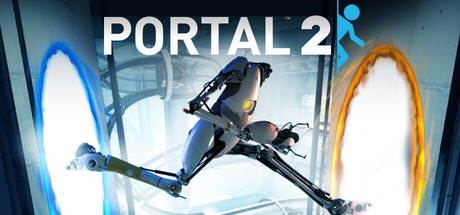
Portal is a single player puzzle game set inside the mysterious Aperture Science Laboratories. You move through a series of test chambers with a portal gun that makes linked openings in certain walls and surfaces. Walk into one portal and you come out the other. The trick is learning to use that simple rule to reach high ledges, cross gaps, move objects, and get around obstacles.
The chambers introduce new problems at a good pace. Early on, you might place one portal on a wall and another on the floor to drop through and build enough speed to launch yourself onto a platform. Later rooms ask you to combine that momentum with buttons, weighted storage cubes, and moving hazards. The companion cube gets its own memorable moment in chamber 17, when you have to use it to solve the room and then follow the instructions for disposing of it. The game is good at making a plain looking room feel like a puzzle box without filling it with clutter.
There is a steady stream of small discoveries, so you are rarely left standing around with nothing to do. You might spot a high ledge, wonder how you could possibly reach it, and then realize that a fall through one portal can send you flying out of another. Getting the angle right feels satisfying, and a mistake usually teaches you something useful instead of sending you through a long replay.
The story comes through the test instructions and GLaDOS’s increasingly odd commentary. Her dry remarks add character without stopping the action for long cut scenes or big blocks of reading. The shift from orderly testing to finding a way out of the facility also gives the campaign a useful change of pace. The ending asks you to use portal placement under more pressure, including redirecting rockets and dealing with GLaDOS’s cores. That is a sharper test of aim than most chambers, but it is brief compared with the puzzle solving that comes before it.
Portal keeps you thinking, but it does not constantly demand split second reactions. You can take a moment to look around a chamber and plan a route. That makes it a strong choice for a workout where you want a game to hold your attention without turning every second into a reflex test.
Category Score: 3 out of 3
Treadmill and Bike Compatibility
Portal has full controller support, which is a real help when you are exercising. You can move and look around with the controller, then use the portal gun to place openings where you need them. The controls are easy to understand, and there is no multiplayer opponent waiting to punish you for taking a break or solving a room at your own pace.
The main catch is aiming. A portal needs to land on a suitable surface, and a small adjustment can matter when you are trying to line up a shot across a room. Jumping through portals also means judging your direction and momentum, especially when a puzzle has you dropping from a height to launch onto a narrow platform. Turrets and the final encounter add a few moments where quick, accurate aiming matters more than usual.
That makes Portal a better fit for a bike or a controlled walking pace than for running at full speed. On a treadmill, keep the pace low enough that looking around and correcting your aim does not become a balancing act. You can also pause between puzzles if you need to settle your footing or catch your breath. It is forgiving enough to work during exercise, but not loose enough for you to ignore the screen and mash buttons.
Category Score: 2 out of 3
Computer Requirements
Portal’s minimum requirements are modest: a 1.7 GHz processor, 512 MB of RAM, and a DirectX 8.1 level graphics card with SSE support. The listed operating systems include Windows 7, Vista, and XP, and the game also calls for a mouse, keyboard, and internet connection. The recommended requirements are still low by current standards, at a Pentium 4 processor running at 3.0 GHz or better, 1 GB of RAM, and a DirectX 9 level graphics card.
In practical terms, this is not a game that asks you to buy a new computer to exercise with it. A very old graphics card or basic integrated graphics should be enough for a game built around simple rooms and clean visual shapes. If your computer can handle ordinary desktop tasks, Portal’s listed requirements are unlikely to be the reason you cannot play.
Category Score: 3 out of 3
Conclusion and Score
Portal is an excellent pick for a steady workout because its puzzles give you something to focus on, while its single player pace lets you think instead of racing a clock through every room. Its portal based movement is clever, the test chambers keep changing their demands, and GLaDOS provides just enough strange commentary to make the trip through Aperture memorable.
The tradeoff is that accurate aiming and careful landings are part of the fun, so this is not the game to pair with your fastest treadmill setting. Use a comfortable pace, especially during the later action, and Portal makes for a smart, funny workout companion. Your legs do the cardio, your brain does the portal geometry, and the weighted storage cube gets a much rougher day than either one.
Overall Score: 2.67 out of 3
More Action reviews